Behavioral Competencies
Proficiency levels
Different roles and role levels require different level of skills.
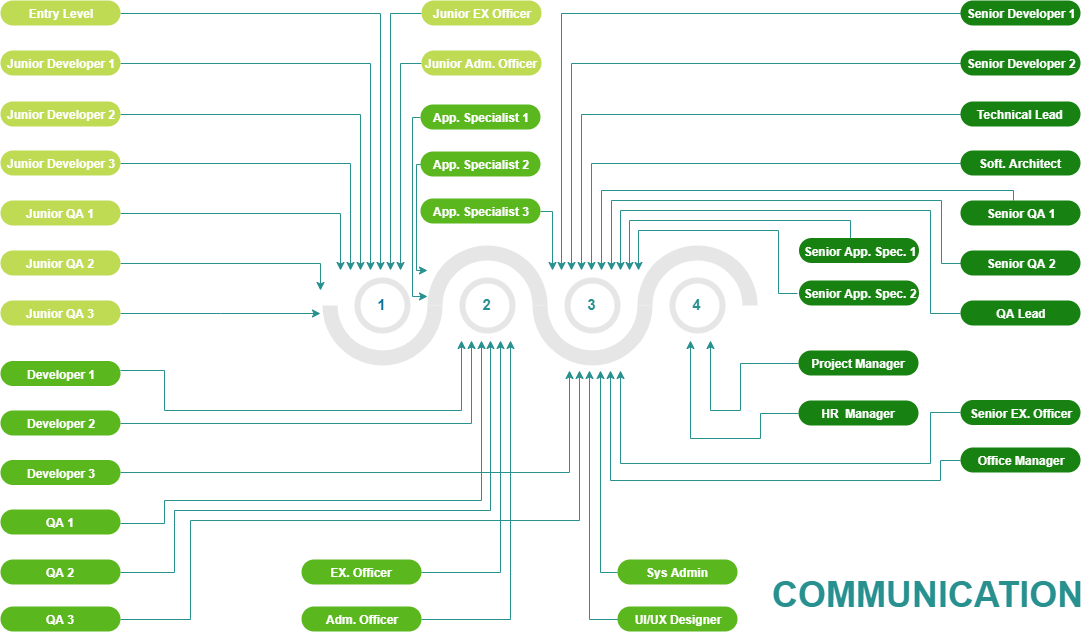
We address this by defining four proficiency levels for each competency. The expected behavior at each level increase in complexity, ranging from the introductory / basic levels to the advanced and expert levels.
Each proficiency level is described in terms of behavioral indicators. The behaviors at each level of the scale are illustrative rather than definitive; that means other examples of behavior are possible. Each competency scale is cumulative which means that, although behaviors from lower levels are not repeated at higher level, they nonetheless apply.
``Never, never, never give up`` - Winstone Churchill
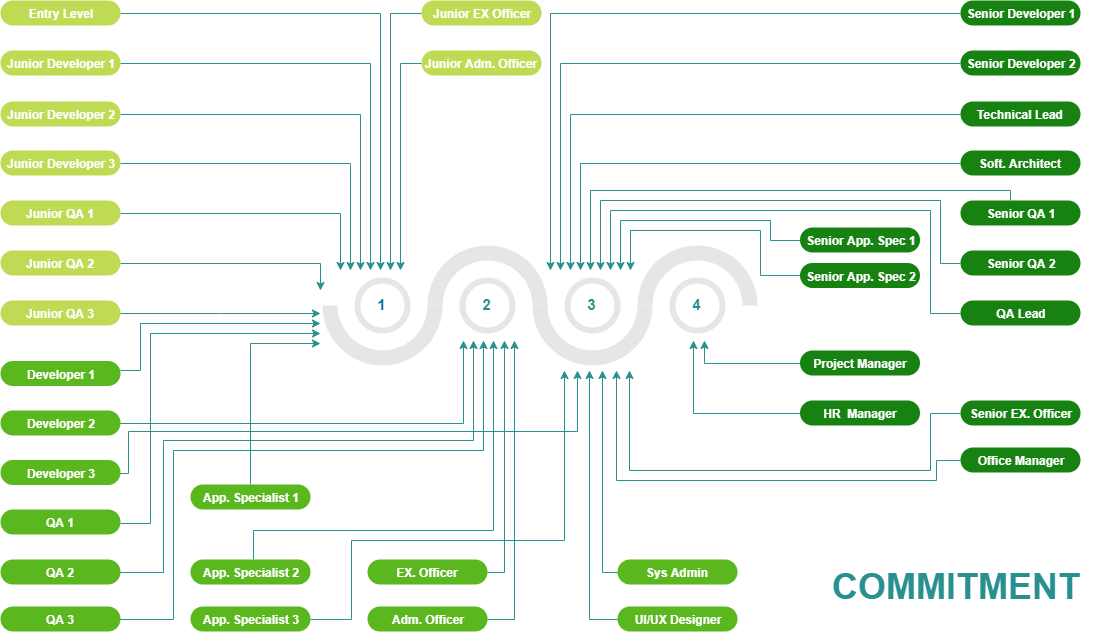
COMMITMENT - to deliver exceptional customer experiences
The willingness to anticipate, meet and exceed the needs and expectations of our customers. It implies working together building long-term relationships, focusing efforts to add value to the business of our customer and to Wayfare. We are committed to delivering exceptional customer experiences. We listen to our customers, striving to understand their challenges, we invest time in finding the most innovative and relevant solution and we put effort into developing, implementing and maintaining it. We keep our promises. We will never let you down because we have the willingness to bind ourselves with your goals and beliefs.
Level 1
- Consistently demonstrates respect when interacting with customers;
- Responds to all inquiries received promptly, positively and in a professional manner;
- Listens actively and asks targeted questions in order to identify and clarify the needs and expectations of our customers;
- Is capable of seeing and understanding the perspective of others, shows respect for their opinions and ideas;
- Asks for help when needed, from more experienced colleagues, in order to ensure that the expectations of the customer are met;
- Keeps the customer informed (acc with our internal processes and/or with customer’s requests);
- Corrects problems promptly and un-defensively when these arise;
- Demonstrates high personal standards and acts as an example for others.
Level 2
- Builds a dialogue with the customer in order to understand his real needs; listens, understands, interprets and reflects back;
- Seeks customer feedback and consistently meets expectations;
- Proactively investigates different ways to improve customer experience;
- Communicates with customers in an assertive manner; explains the rationale for action, comes up with alternative solutions where possible and/or improvements, corrects problems before they become critical;
- Takes pride in delivering high-quality work and takes ownership of the results.
Level 3
- Excellent customer experience is a priority; regularly checks out whether the customer is satisfied and their expectations are being met even if these are demanding;
- Shows willingness to take responsibility for solving customer’s problems; is proactive and ‘goes the extra mile’ to help a customer;
- Is a role model for the rest of the team, discusses openly, encourages, advises, corrects,and trains colleagues on how to improve the relationship with the customer;
- Actively promotes the company’s core values and standards to colleagues and others (embraces them, proud of, believes in, loyal, satisfied, finds meaning and sense of purpose);
- Challenges unappropriated behaviour, avoids non-assertive comments;
- Is active in supporting changes and in supporting the goals of the company, cooperates with others, regardless of position or hierarchy, in order to achieve the priorities and key business objectives;
- Assumes tasks outside his job role (either less interesting or outside the comfort zone) of great impact on the company’s goals;
- Proves solidarity with the team and customer in critical situations.
Level 4
- Builds and maintains a customer-oriented environment and strong partnerships with potential and existing clients, leads the team and acts as the primary role model in customer focus approach;
- Pro-actively looks for ways to make processes/procedures more customer-friendly, identifies and creates good practices, solutions, standards and improvement plans and challenges the company to integrate them into our way of working in order to continuously increase the delivery of high-quality services;
- Pushes other colleagues to see things from the customers’ perspective;
- Develops an understanding of the customer environment in order to anticipate needs, actively engages the team in maximizing the value added to our customers;
- Gains the trust of the customer, becomes involved in the customer’s decision-making processes, works to exceed customers’ expectations by suggesting new, more cost-effective, fast and easy solutions.
Always
avoids doing
Does not treat all customers with respect, talks dismissively about customers, treats complains as a nuisance/annoyance, is not flexible/sensitive to customers’ needs and concerns. Doesn’t listen and talks over the customer, is rude or impatient.
Is inflexible about own system and own way of doing things. Has a ‘that’s not my job’ mentality, shows a disinterested attitude towards the client and colleagues.
Fails to deliver, makes promises that cannot be kept, fails to respond to customer inquiries in a timely and appropriate manner.
Does not to see things from the customer’s point of view, avoids getting feedback from the customer or keeps it for him/herself without doing anything to correct/improve the situation. Focuses on own objectives and activities without considering the issues and goals of the company. Fails to follow through on key goals because they are unpopular or difficult to carry out.
Does not to see things from the customer’s point of view, avoids getting feedback from the customer or keeps it for him/herself without doing anything to correct/improve the situation. Focuses on own objectives and activities without considering the issues and goals of the company. Fails to follow through on key goals because they are unpopular or difficult to carry out.
``Fresh thinking that creates value`` - Richard Lyons
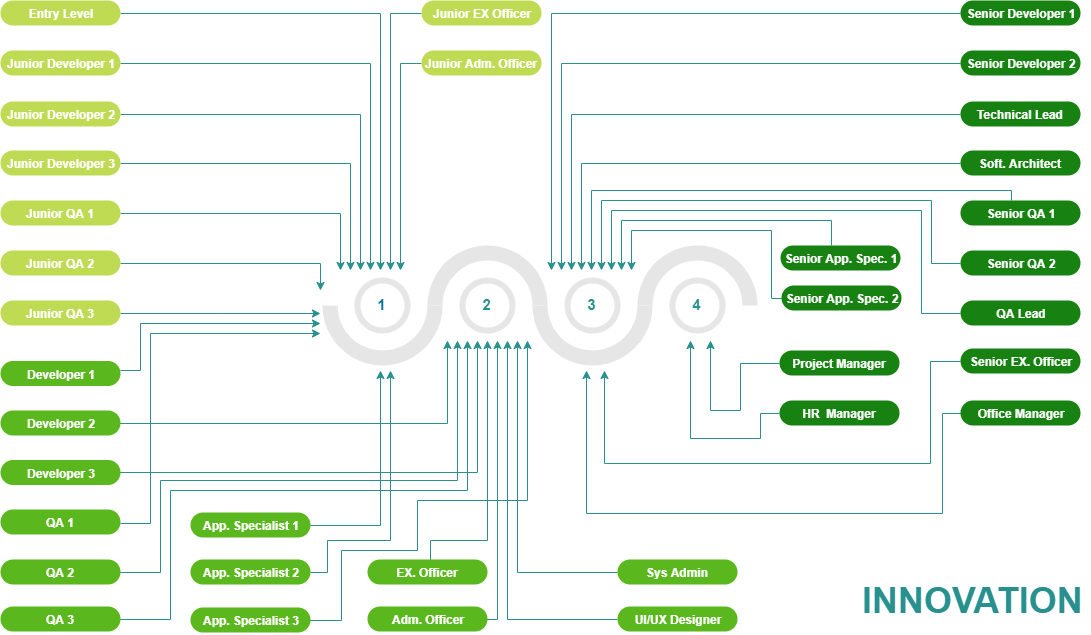
INNOVATION - we are naturally curious about technology & about people
We are aware of the importance of questioning conventional approaches of identifying and exploring new ones in order to address existent technical, operational and commercial challenges. New ideas will enable the company to move forward to develop new or improved processes, methods, solutions and to deliver better services. In our understanding, innovation is a “significant positive change” of something, when our result is embraced and used by others who have experienced that problem. It’s a result, it’s an outcome, it’s something we work on, for solving an existent problem or an anticipated one. We explore every day how technology can be used to mold our creative ideas into real solutions that will be perceived as valuable by our customers and by us.
Level 1
- Recognizes and embraces the efforts done in the company to improve our way of doing things;
- Identifies similarities and differences between the current and past situations, sees patterns and missing pieces, questions currently accepted ways of doing things;
- Recognizes good ideas from similar situations and proposes them to be used;
- Tries new methods for completing required tasks more efficiently.
Level 2
- Develops new approaches to improve or replace existing processes, procedures or systems;
- Is open-minded and actively seeks new ideas, is open to hearing new approaches proposed by others;
- Evaluates alternatives before settling on a solution and has a good judgment of which ideas and suggestions will work.
Level 3
- Looks beyond the obvious and immediate information when looking for a solution;
- Has an open and flexible approach, tries different and original ways to deal with problems and opportunities;
- Facilitates innovation by creating opportunities for discussing new ideas, actively encourages and supports creative and innovative thinking in others and generates ideas to the benefit of the team or of the overall company.
Level 4
- Fosters a learning culture, committed to continuous improvement and development;
- Facilitates the implementation of innovative ideas;
- Looks at things in a really new way – breakthrough thinking which will move the company forward;
- Translates creative ideas into strategies and defines action plans with a high success rate.
Always
avoids doing
Not open to new ideas, is satisfied with the status quo and does not challenge it; continues with old ways of doing things despite requests for change.
Gets bogged down in the detail and cannot see the bigger picture; can only see the immediate problem or spot the obvious connections, uses only typical alternatives.
``Doing the right thing at all times and in all circumstances`` - Thomas S. Monson
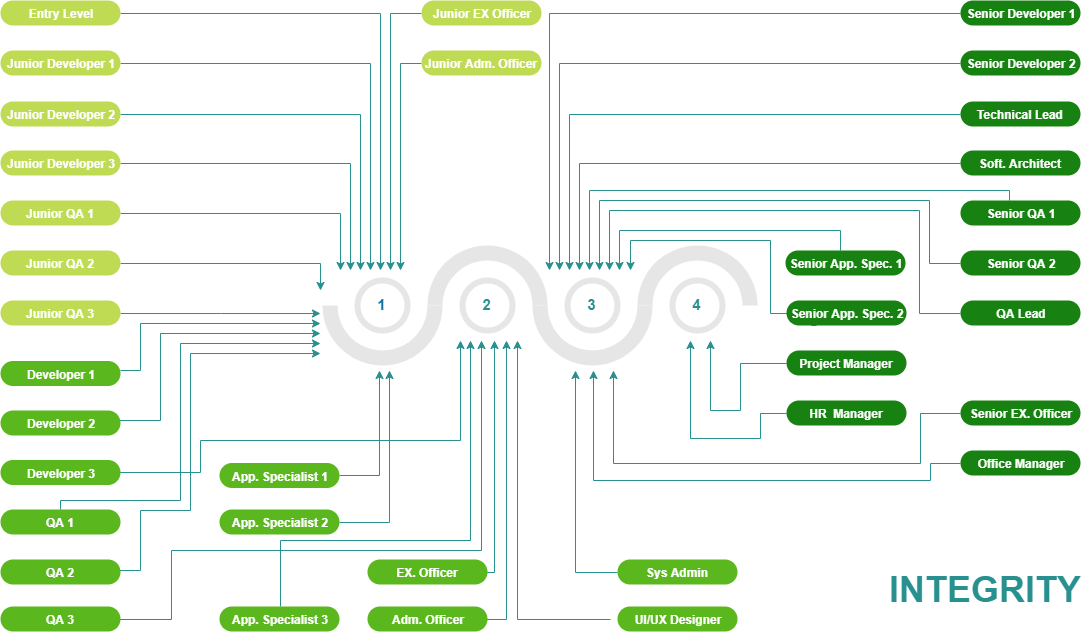
INTEGRITY - the value of trust that others have in us
If we could choose only one value to live by, it should be Integrity. It means to behave in an honest, fair and ethical manner, showing consistency in words and actions, regardless of the situation. It’s about demonstrating commitment to openness, taking time to understand others and to respect them. At Wayfare, the value of trust that others have in us is far beyond anything that can be measured. We are honest, fair and we have strong moral and ethical beliefs. We are aware that it takes years to build a reputation of integrity, but only a second to lose it. So, we will never allow ourselves to do anything that would damage it because the price to be paid is incredibly high. We aim to have the wisdom and the courage to always do what is right, no matter the consequences. We see it as the most valuable quality anyone can have in their life, a personal & uncompromised choice.
Level 1
- Treats others fairly and with respect;
- Is aware of the feelings of others, is approachable and patient;
- Has respect for others’ knowledge and/or experiences, listens to their concerns, issues and opinions;
- Behaves and expresses oneself in an open and honest manner, even when is hard to do so;
- Is open to receiving and encouraging feedback, takes responsibility for own work (including problems and issues);
- Is consistent in words and actions, gives only commitments that can be met and ensures these are honoured;
- Shares information accurately, completely, appropriately and on time.
Level 2
- Is widely trusted and seen as a person who presents truthful information in a helpful manner;
- Encourages others to value each other and challenge, assertively, those who don’t, even if they are more experienced;
- Reads other people’s reactions and body language accurately, shows empathy, listens in order to understand the views and needs of others;
- Is willing to publicly admit when makes a mistake;
- Understands how own actions can have an impact on the team, on the company, on the clients’ business, and on self.
Level 3
- Is known to consistently adhere to ethical principles and expects others to follow them as well;
- Is respected as a credible source, does not compromise on matters of ethics and is indisputably trusted to protect sensitive information, even to his or her own detriment;
- Builds trust, through modelling desired behaviours, actively promotes our values;
- Is honest about aspirations and agendas, particularly in relationships with colleagues;
- Takes responsibility when fair behaviour is not embraced (corrects others, mentors them, advises them).
Level 4
- Builds and fosters an environment where integrity is in every action taken, promotes a climate of openness and honesty;
- Observes, anticipates and acts with regard to issues of fairness, transparency and honesty;
- Recognizes and praises people who follow through and demonstrates fair actions in challenging unethical or dishonest behaviours;
- Publicly demonstrates respect for other organizations or cultures.
Always
avoids doing
Is disrespectful about colleagues and customers; is not consistent – “does not walk the talk”, says one thing and does another; tries to influence opinions by presenting only part of the truth or by hiding information;
Fails in understanding the reason for someone’s behaviour but still, may be too direct, which may catch people off guard and make them feel uncomfortable; may push openness and honesty to the point of being disruptive.
``No one can whistle a symphony. It takes an orchestra to play it`` - H.E. Luccock
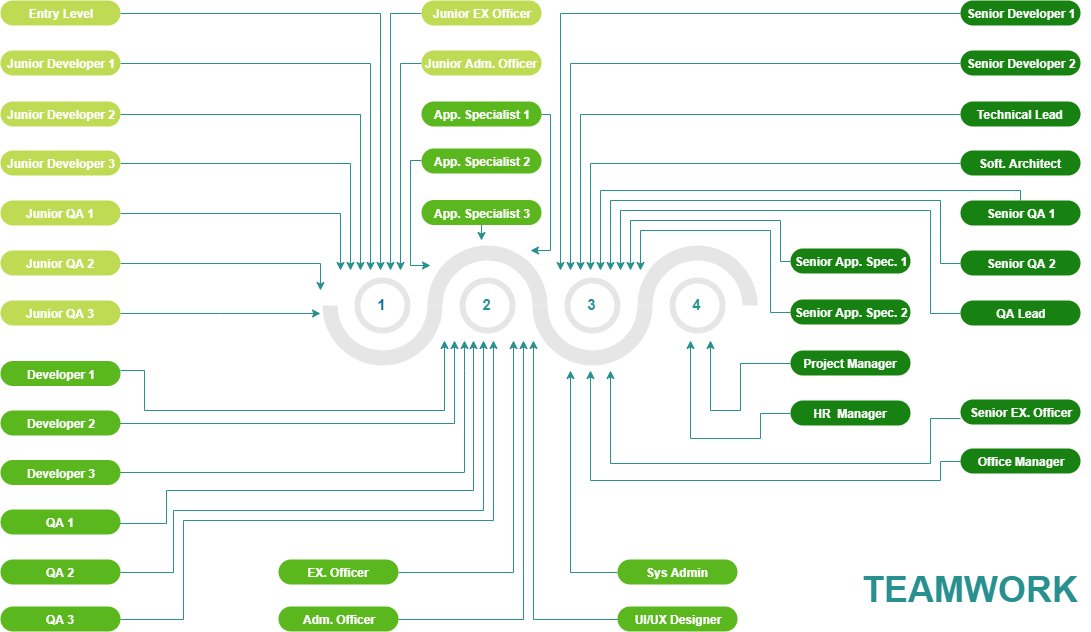
TEAMWORK - is about working together
Is about working together, cohesively, towards a common goal, creating a positive working atmosphere, and supporting each other to combine individual strengths to enhance team performance. It’s about pro-actively contributing to the capability of the team, sharing responsibility and rewards and getting the task done in the most effective and efficient way. There is no way we can truly succeed 100% alone. We need the strength of our teammates to complement our own weaknesses, the freshness of others’ perspectives to find the best solutions, the moral support that comes from knowing that our colleagues are here, ready to support us in any moment to move forward. We trust, respect and we care about each other! We cherish the value of teamwork. We know that we are more powerful together.
Level 1
- Willingly co-operates towards the accomplishment of the team’s tasks and goals, doing his or her share of the work and working collaboratively rather than competitively;
- Knows own limitations – who to go to for help and when, is not afraid to seek advice from others;
- Is willing to accept compromises to progress toward the achievement of the team goals;
- Proactively shares knowledge, experiences and information with the rest of the team.
Level 2
- Is a good team player, accepts responsibility for team objectives, recognizes when help is needed and willingly offers support or responds positively to a request for help;
- Puts in extra effort when needed to help others, follows through on commitments made to other team members;
- Is courteous, tactful and diplomatic, demonstrates respect for the opinions and ideas of others and accepts when others have a valid point.
Level 3
- Proactively builds team spirit – ensures participation of others (or consults others) who are affected by plans or actions, ensures that everyone’s view is considered, notices people who seem to be ‘left out’ and seeks to involve them;
- Puts team’s agenda and the good of the whole ahead of personal ambitions, asks for their ideas and opinions and works together for solutions and plans, builds support, enthusiasm and energizes people to work together for the accomplishment of team goals;
- Takes responsibility for the accomplishment of team goals, finds ways to remove obstacles to team success, addresses conflicts or issues within the team in a positive and open manner;
- Provides constructive feedback to team members, spends time helping others think through an issue or solving work problems;
- Openly praises other members of the team when they have done something well, speaks positively of others, encourages colleagues after a setback and gives recognition and credit to people who have contributed to team success.
Level 4
- Fosters team spirit and collaboration within teams;
- Identifies what motivates different individuals and uses this knowledge to improve performance;
- Encourages individuals to address and resolve conflicts within the team, creates opportunities for individuals to work together breaking down barriers that may get in the way of effective teamworking;
- Acts to promote a friendly climate and cooperation;
- Supports and encourages other team members to achieve objectives;
- Encourages others to share experiences, knowledge and best practices with the team;
- Encourages the team to openly discuss what can be done to create a better solution or alternative; challenges others to do the same.
Always
avoids doing
Prefers to work alone rather than as a member of a team; fails to share with other people information that would enable them to do their job more effectively or does not share it in time; has minimal contribution to achievement of team goals and objectives, co-operates selectively, expresses very often negative expectations.
Sees himself better than others and fails to respect their contribution; makes negative comments about others either personally or professionally; have a “That’s not my job”, “I’m far too busy” attitude; is secretive and evasive, always puts own needs above team’s needs;
``The single biggest problem in communication is the illusion that it has taken place`` - G. Bernard Shaw
COMMUNICATION - understanding emotions and intentions behind the information
It is no doubt that communication plays a vital role in our life. A clear & effective communication leads to a more satisfying life. It helps us to have clarity around, to build strong working relationships, to reduce misunderstandings that may cause stress and pressure, to increase our satisfaction at work therefore to increase the quality of our life. It is essential to understand others and to make sure that the message conveyed by us is received and understood in exactly the way we Intended. Communication is more than just exchanging information. It's about understanding the emotions and intentions behind the information. People often focus on what they should say, but effective communication is about listening as much as it is about talking. Listening means not just understanding the words or the information being communicated, but also understanding how the speaker feels about what they’re communicating. When you really listen, you make the other person feel heard & understood & this can help to build a stronger connection between you.
Level 1
- Communicates both, verbally and in writing, in a clear, polite, well-structured and easy-to-understand way;
- Listens effectively and without interrupting, checks own understanding of others’ communication, asks clear and relevant questions, shows openness in communicating with others;
- Presents things in a clear and concise manner, using facts and figures, using ‘pros’ and ‘cons’ arguments.
Level 2
- Communicates in an accurate, without ambiguity and timely manner;
- Acts to keep self-informed, points out the benefits of following a route or taking a particular action, asks for feedback on what has been said;
- Fosters the dialogue, capable to handle questions and to discuss issues in an assertive manner, without being defensive or aggressive, maintaining the dignity of others.
Level 3
- Considers the perspective of others, gives the right information at the right time to the right people;
- Is capable to anticipate the reaction of others and to adapt communication accordingly; is aware of the impact that own words, actions, and behaviour have on others;
- Communicates in an engaging and proactive manner,
- Shows interest in other people’s views and is always approachable and open-minded.
Level 4
- Adapts communication to achieve specific objectives;
- Communicates complex issues clearly and credibly with widely varied audiences, is capable to deliver difficult or unpopular messages with clarity, tact, and diplomacy;
- Communicates persuasively when required;
- Sets up processes to improve information flow, is engaged in sharing and seeks to develop mutual understanding.
Always
avoids doing
Withholds information or provides inaccurate or misleading information; is unapproachable, tends not to listen to others; avoids communication if the message to be transmitted is difficult or perceived as unpopular.
Uses too many details and lose the attention of others; tends to over-dramatize information or tends to present information in a negative way.